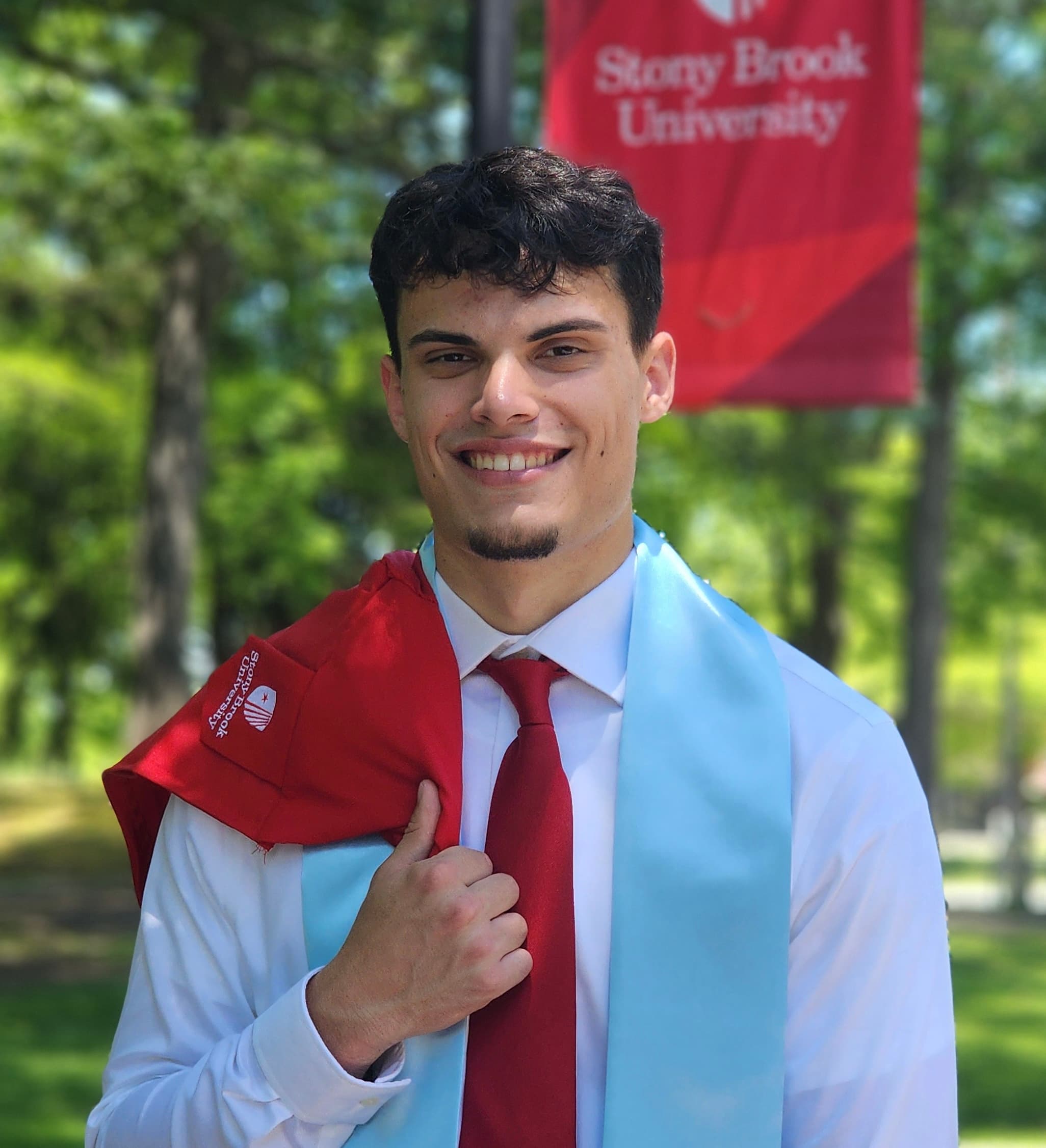
Jason Bokinz
Full Stack Software Engineer
I'm passionate about building AI products and building with AI, along with the systems around both that let things scale confidently and efficiently. As a founding engineer at whiz.study, a fast-moving EdTech startup, I helped grow the platform to 100,000+ users in a year and a half. I built the AI tutor that now powers 1,600+ paid subscriptions and led Contentinator, an AI content generation pipeline that has saved $296,000. I also co-led a rebuild of 300,000 lines of code onto a new layered architecture in four months, built to scale safely with AI coding agents. I'm looking for my next team where I can bring that same kind of impact.
Languages








When I'm not coding
 Basketball
 Lifting
 Golfing
 Beach
Beach
Stony Brook University
Bachelor of Science in Computer Science — Artificial Intelligence
Graduated May 2025
Coursework
Courses That Shaped Me
Systems Fundamentals II
CSE 320 was the hardest class I took at Stony Brook, the kind with a reputation for pushing people out of the major. The work was low-level C and systems programming, and instead of just trying to pass, I pushed for perfection. I tested every edge case I could think of and tried to break my own code before the grader could. That standard showed up in the grades: I scored 100s on three of the projects, where much of the class was in the 40s and 60s, and I finished with an A. But the grade mattered less than what it built in me: staying calm under hard problems, planning my work across long deadlines, and always thinking about what could go wrong before it does.
Natural Language Processing
This is the class that got me into AI. We went deep into how large language models actually work, with hands-on assignments in prompt engineering, text embeddings, retrieval, and why models hallucinate. For the first time I understood what was happening under the hood instead of just using the tools. We also covered different ways to benchmark these models, which is what led me to build my own RAG project outside of class to compare them. It's the reason I do the AI work I do today.
Software Engineering
This was the first class that felt like a real software job instead of homework. We built one project over the semester with a deadline for each phase, designed our screens in Figma first and then built to match them, and worked as a team that split up the tasks. There was no set direction, so we picked our own stack and planned who did what, opened PRs, reviewed each other's code, and worked through merge conflicts. I came out of it knowing how to write code other people can read and how to ship as a team, not just on my own.
Software Development
This is where I first learned front end. We built the same project over and over, starting bare with plain HTML, CSS, and vanilla JavaScript, then leveling up to React and Tailwind so I could see how the fundamentals work before the frameworks hide them. It's also where the bigger picture clicked: the difference between what runs on the server and what runs in the client, how each side handles rendering, and where React actually fits into it. It was the first end to end web app I ever built, and where I got comfortable owning a feature across the whole stack.
Experience

West Palm Test Prep
Software Development Engineer II
June 2025 - PresentRebuilt a 300,000+ line monolith into domain-driven modules with 2 other engineers in under 4 months, sharing one ubiquitous language with the business, using Claude Code for large-scale refactoring.
Engineered the codebase to support AI coding agents, writing the guardrail documentation and Claude Skills that let them navigate and make large changes safely, with automated checks that block violations.
Led 2 engineers in building an AI content generation pipeline that authors questions for any exam, producing 75,000+ questions in 2 months, saving nearly $296,000 versus human authoring.
Designed the frontend SDK by abstracting each part of the frontend into its own layer, from the branding styles through the React components to the stores, so any client can build on any layer.
Software Development Engineer Intern
January 2024 - June 2025Launched whiz.study as a founding engineer, growing the AI-powered EdTech platform from zero to 100,000+ users across iOS and web, maintaining the TypeScript business logic and PostgreSQL queries carrying that traffic.
Owned the platform's top subscription driver, an agentic AI tutor reading a question's content and additional tools provided like a calculator or reference sheet to walk students through the problem in words and on-screen cues.
Built payment infrastructure covering Stripe subscriptions, one-time payments, and a custom free-trial entitlement system, processing 1,600+ active paid subscriptions across the platform.
Developed a multi-tenant B2B service in the same monorepo where organizations manage members under role-based access control, run classes, enroll students, assign homework, and track activity on the main platform.
Projects
Iron Coach
2026Created a weight training app that logs every set from a 150+ exercise catalog and tracks each lift over time, showing exactly which movements are getting stronger and which have stalled.
Architected an agentic AI coach that turns a fitness goal into a full workout plan, laying out every set down to the rep, grounded through RAG in training research and the user's own workout history.
Implemented mid-workout suggestions to maximize the next set's value toward the user's stated goal, weighing recent sessions of that lift against the set just logged.
Retirement Planning Simulator
Spring 2025A Monte Carlo retirement simulator spawning a parallel Bun worker per path, simulating 40–60 year horizons through a 10-stage annual pipeline into year-by-year success-probability projections.
Implemented financial algorithms including Roth conversion bracket-fill optimization, Required Minimum Distribution calculations, and ordered asset liquidation across 3 account types.
Automated IRS data ingestion with Puppeteer scrapers across 4 IRS sources (tax brackets, deductions, capital gains, RMD tables), persisting year-stamped records to PostgreSQL.
Dynamic Memory Allocator
Fall 2024Implemented a custom dynamic memory allocator in C, replacing the standard library's malloc, free, realloc, and memalign with a hand-built heap manager operating directly on raw memory.
Designed segregated free lists partitioned by size class with a first-fit placement policy, using boundary-tag headers and footers to coalesce adjacent free blocks in constant time.
Engineered block splitting without splinters, enforced 64-byte payload alignment, and validated correctness with a Criterion unit test suite.
RAG Hallucination Benchmarking
Fall 2024A methodology study on reducing LLM hallucination in educational Q&A. Developed an end-to-end RAG pipeline using OpenAI text-embedding-3-large embeddings and Pinecone vector search, grounding GPT-4o-mini responses in retrieved reference material.
Benchmarked zero-shot, few-shot, and chain-of-thought prompting across 1,000+ GPT-4o-mini and GPT-4o responses, scoring factual consistency via cosine similarity against reference embeddings.
Found retrieval grounding improved factual consistency across question types, with chain-of-thought prompting driving the largest gains on reasoning-heavy questions and diminishing returns on stronger models.
HoopMetrics — NBA Team Data Explorer
Summer 2024Built a Python desktop app that scrapes and displays live data for all 30 NBA teams from NBA.com, organized into tabbed views for rosters, player and team stats, coaching staff, and franchise history.
Built a head-to-head player comparison view rendering two players' full stat lines side by side for direct comparison.
Engineered Selenium scrapers pulling multiple live data feeds per team, with a team-ID lookup table to fetch each team's data efficiently.
Let's Work Together
I'm currently looking for full-time opportunities and open to freelance or contract work. If you have a role, a project, or an idea you'd like to discuss, I'd love to hear from you.